
What is the Difference Between a Balance and a Scale?
Balance or Scale: Do You Know the Difference?
If you’ve ever used the words scale and balance as synonyms that can be used to describe any equipment that measures weight, you’re not alone. It’s easy to assume that because the functions appear so similar (set an object down and get a digital number response) to assume the technologies are identical. And there is even a historical reason for the confusion.
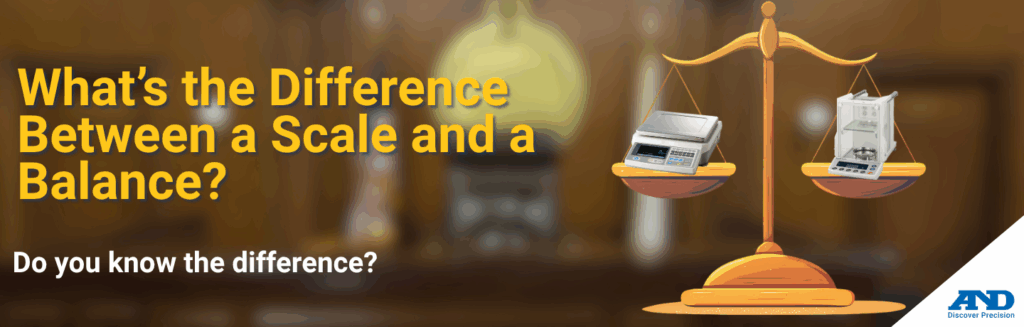
Both scales and balances have their technology rooted in one of the earliest forms of measurement mankind ever created: the balance scale (which is why we use bother terms). If you immediately pictured a blindfolded woman holding two plates hanging from chains connected to an arm that can seesaw back and forth, you’re right!
This was the earliest known form of comparative weighing, and it became the cornerstone of how scales and balances have developed since. Both scales and balances still give accurate readings by performing a comparison to determine how much of a sample was placed on them and what it weighs.
But as scales and balances have developed over the centuries, their core technologies have become very different. And that difference has impacted the applications they are appropriate for and which one will be most appropriate for you.

Balance Technology vs. Scale Technology
Balances and Scales have been designed to calculate weight in entirely different ways, but what is the actual difference between them?
Balances
Balances measure the mass of the object (or objects) set on their pan. They do this through a process called force restoration, which is the modern day, electrical version of putting an object of similar weight on the other side of the balance scale.
Essentially, underneath a balance’s pan there is a lever connected to a magnet, and an electric current that keeps the magnet in its current position. When something is placed on the pan, it forces the lever to move the magnet. The balance increases the electric current in response to push the magnet back to its original position, literally balancing the weight of the object on the pan and bringing it to a net zero. Based on the current needed to reach equilibrium, the balance calculates an accurate reading of how much the object weighs.
Scales
Scales, on the other hand, measure the force of gravity on the object (or objects) set on them. Inside the scale there are strain gauge load cells.
The cells deflect under pressure of the weight, which in turn bends the strain gauge and changes its electrical output. Essentially, the scale knows that X electrical current = X amount of weight (in imperial or metric units). This value is pre-calculated using the weight formula which equals force times mass.
The way these weights are determined is the key difference between the technologies and why they are useful for completely different applications now.
Balances compare the mass of what is on their plate to an unknown value (how much current the magnet needs to reach equilibrium) to calculate weight, whereas Scales compare the structural change in the gauge to a known value (what the returned current equals in mass).
Differences in Application
But why does this difference in mass vs. force or unknown vs. known decide what applications Balances and Scales can be used for? The keys here are accuracy, speed, and capacity.
Because Balances calculate the mass as opposed to using a simple chart comparison, they can read weights more accurately than scales (down to 0.000001g). But the time it takes to make that calculation means that Scales can produce results faster. Additionally, the internal mechanics of a Balance are much more complicated, so it can be cost-prohibitive to produce Balances with the capacity that Scales can handle.
Therefore, Balances are best for applications that need highly precise, repeatable or traceable measurements of small, low weight samples.
Scales are best for applications that measure large, heavy samples where speed is important and accuracies to .01g are sufficient.
Balances
Scales
Lab research and sample prep
Pharmaceutical compounding
Precision manufacturing (e.g. Semi-conductors)
Environmental testing
Jewelry/Precious metal weighing
Analytical Chemistry
R&D
Recipe development
Industrial batching and mixing
Feed and grain weighing
Inventory management and bulk weighing
Food processing and portion control
Agricultural weighing
Shipping and receiving
Packaging and Checkweighing
Construction and materials handling
How to Know Whether You Need a Balance or a Scale
If you’re unsure whether you need a balance or scale for your application, answering these questions can help you make the right choice.
- What capacity do I need to weigh?
Knowing the approximate weight of each sample or group of samples that you will weigh at a time is the best determination of what equipment you will need. The smaller the sample, the more likely you will need a balance, especially when you get down to a few hundred grams or less.
- What level of readability do I need?
You can also think of this as how accurate do I need the sample reading to be. As mentioned earlier, balances can measure down to 0.000001 g. So, if you need to ensure your samples are properly sized to that level of precision, you will need a balance. But if you only need to be accurate to a few tenths of a gram, a scale will get you what you need.
- What environment will I be measuring in?
Balances are precision instruments, and they operate best in a lab where there are few environmental impacts that can disrupt their accuracy. Scales are designed for industrial environments and are more often IP rated to keep out water, dust, or other contaminants that could disrupt the measurement or impair accuracy.
- How much am I able to spend?
As mentioned earlier, balances have more complex internal mechanics that make them the precision measuring powerhouses they are. But that also makes them more expensive. If price is a limiting factor, a scale may be your best option for fast results.
A&D Weighing features a wide-range of Balances (Analytical, Precision, Micro, and Semi-Micro) and Scales (Bench, Counting, and Compact) for all of the applications listed above and more. Visit the links above or fill out the form below to learn more and request a quote today.
Sources:
https://www.sciencing.com/difference-between-scale-balance-6465915/
https://blog.certifiedmtp.com/balance-vs-scale-which-one-to-use-and-when/